
+44 1252 624411 info@liquid-lamination.co.uk Water-based and UV liquid laminates · Inkjet sprays · Coating machines
Applications
Food-service interiors are tough on print. Walls near tables catch splashes, menu panels are wiped many times a day, and kitchens bring degreasers into the mix. A liquid coating chosen for the actual cleaning regime helps restaurant and café graphics stay legible and attractive between refits. This page focuses on what makes these spaces different and how to specify for them.
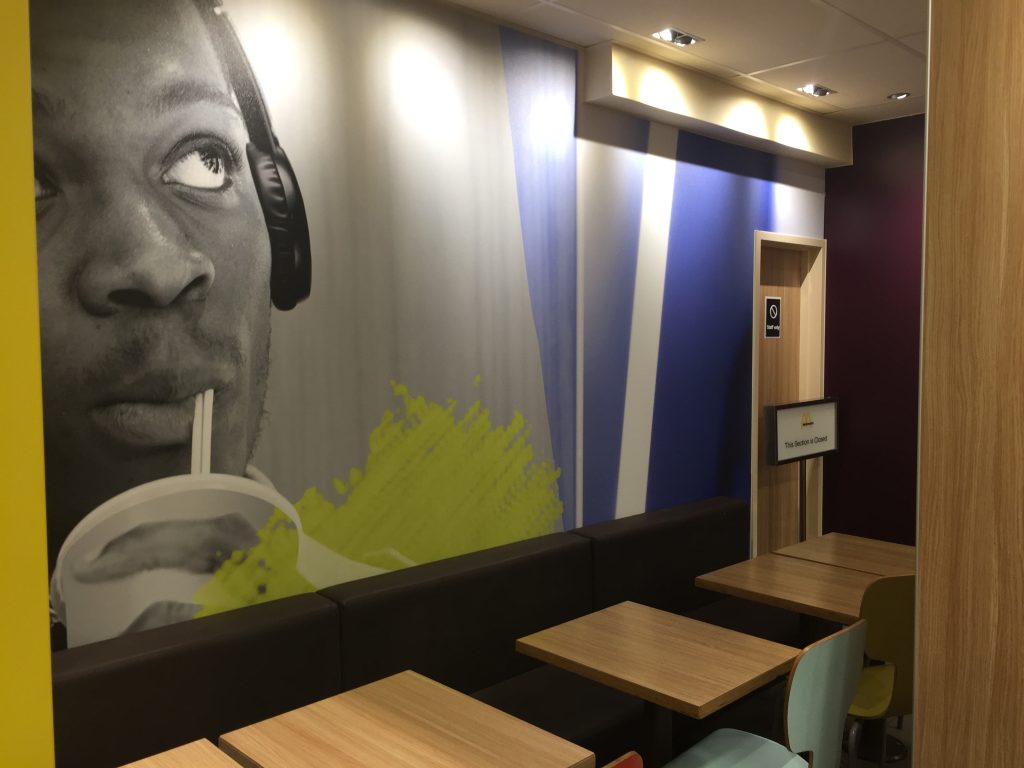
In a reception or office, a wall graphic may be touched occasionally and cleaned weekly. In a café or restaurant the pattern is very different. Landor’s guidance on protective coatings for digital wallpaper notes that in cafés, leisure venues and food-service settings, the coating may need to cope with more frequent cleaning and occasional splashes.
Typical stresses include:
Replacing a damaged wall can mean reprinting, rematching colour and closing off part of the dining room, so protecting the print at production stage is usually the more sensible choice than repairing it later.
Printed menus, price boards and counter graphics have to stay readable while being wiped constantly. Landor notes that a gloss finish can be particularly effective for menu panels, point-of-sale displays and vibrant retail-style graphics where colour depth and easy wipe-down matter. Gloss can make dirt more visible, but it also makes routine cleaning straightforward.
It is worth remembering that gloss, satin and matt describe appearance, not chemical resistance. Resistance comes mainly from the coating chemistry and how well it has cured. A finish that copes with a neutral detergent may react differently to an alcohol-based sanitiser or an alkaline degreaser, so the cleaning products should be part of the specification from the start.
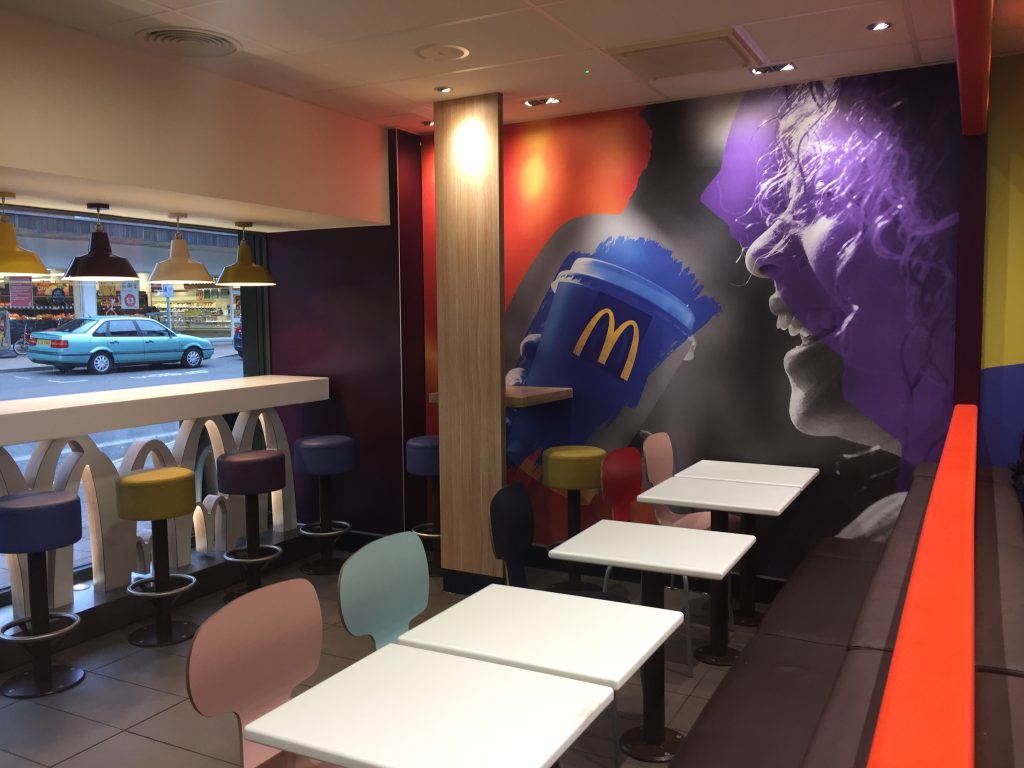
Graphics near kitchens and food preparation areas face stronger chemistry than dining rooms. Landor highlights alkaline degreasers used in kitchens as more demanding than ordinary surface cleaners, and solvent-containing cleaners as a risk to unsuitable finishes. The method matters as much as the liquid: a diluted cleaner wiped briefly is very different from a concentrated product left to dwell and then scrubbed.
If a graphic will be installed across a restaurant chain, a small compatibility test is a sensible precaution. Use the production print and coating, cure it fully, then repeat realistic wipe cycles with the cloths and cleaners used on site. Check for softening, whitening, loss of gloss and lifting at edges. Landor’s article on which finish resists cleaning chemicals covers this test in more detail.
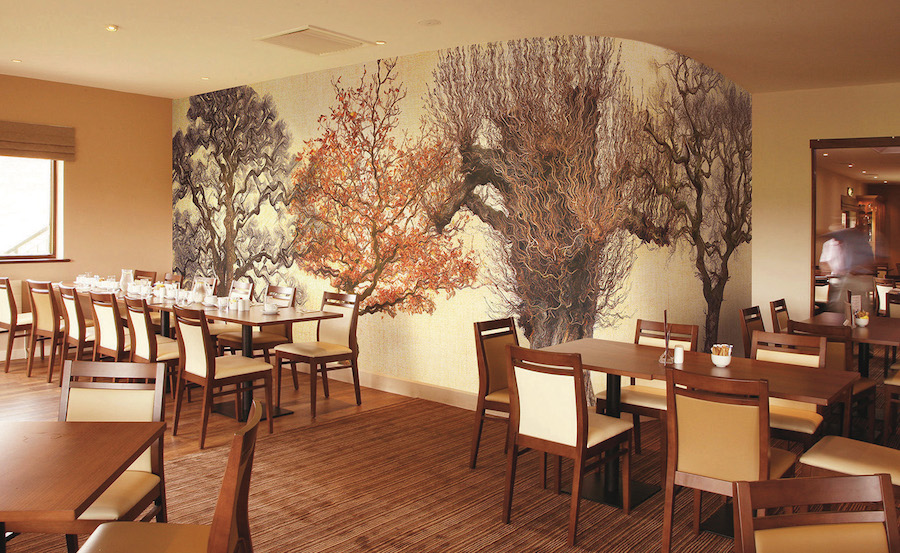
At Birchwood Park golf club, owned by Burhill Golf and Leisure, a large blank wall once dominated the restaurant. Artist and photographer Martin Thompson worked with the club on ideas, colour schemes and visualisations, and installed a tree frieze printed on Landor Phototex. The club was pleased enough to commission a four-panel installation at its Aldwickbury Park club. Martin describes Phototex combined with a liquid laminate as very durable, which is the pairing that suits a busy dining room: a removable fabric wallcovering with a clear protective coat on top.
For tables, counters and other high-touch printed surfaces, ColourShield Safetouch is an anti-microbial clear coating tested to the ISO 22196 standard. Landor lists restaurants and cafeterias among the environments it is intended for. It is designed to help inhibit microbial growth on the coated surface and works alongside normal cleaning; it does not replace cleaning or sterilisation routines. Phototex can also be supplied coated with Safetouch where a surface should not be damaged. More on this is on the ColourShield Safetouch page.
Whatever the coating, give the venue clear care instructions at handover: the approved cleaner, dilution and cloth type, and any products to avoid.
Landor’s general advice is a soft cloth or sponge with warm water and a mild detergent, testing a small area first. Avoid abrasive scrubbing, which can damage the coating and make it easier for dirt to build up.
Gloss suits menu panels where colour depth and wipe-down matter, but under strong lighting satin may be easier to read. Choose the finish for appearance, then confirm chemical resistance by testing.
Often, yes. Liquid laminates can be applied to installed graphics by roller, brush or pad, provided the surface is clean and dry. Test a small area first to check adhesion and appearance.
Call +44 1252 624411 or email info@liquid-lamination.co.uk for advice, samples and pricing.
