
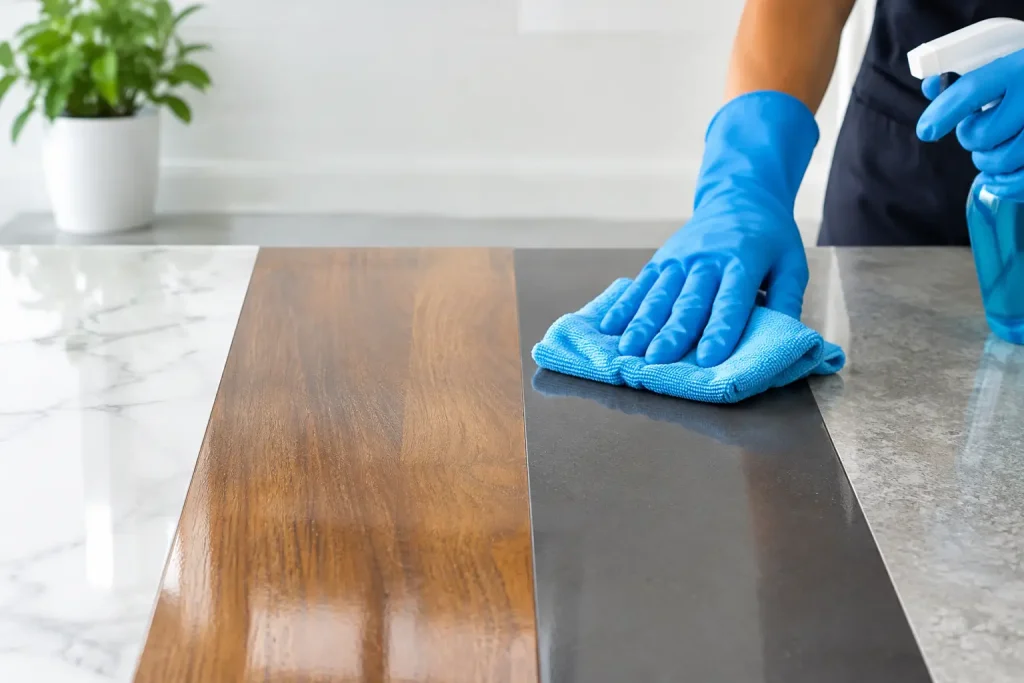
A reception wall graphic can look perfect on installation day, then lose its impact within months of repeated wipe-downs. Hand sanitiser splashes, detergent residues, disinfectant sprays and abrasive cloths gradually attack the printed surface. The question is not simply which finish resists cleaning chemicals – it is whether the complete coating system has been selected, applied and cured for the cleaning regime the graphic will actually face.
For digitally printed graphics, chemical resistance comes primarily from the coating chemistry and cure, not from whether the visible finish is gloss, satin or matt. A well-formulated protective liquid laminate can retain the desired appearance while creating a washable barrier over the ink and substrate. This protects the print, reduces premature replacement and avoids the material use associated with repeatedly renewing damaged graphics.
The short answer: choose a crosslinked protective coating
Where regular cleaning is expected, a high-performance liquid coating designed for repeated cleaning is usually the right starting point. Water-based liquid laminate systems can provide excellent protection for many interior and exterior graphics once fully cured. UV-curable coatings provide a tougher, highly crosslinked surface and are particularly relevant where rapid production, high throughput or demanding wear conditions are part of the brief.
Neither category should be treated as automatically chemical-proof. Resistance depends on the formulation, coating weight, substrate, ink system, curing conditions and the chemical being used. A finish that withstands a neutral detergent may react differently to alcohol-based sanitiser, bleach-based disinfectant, solvent cleaner or alkaline degreaser.
The practical specification is therefore: select a protective coating with proven resistance to the intended cleaning agents, then choose gloss, satin or matt according to the required visual result.
Gloss, satin and matt: appearance is not chemical resistance
It is easy to assume that gloss is the most protective option because it appears smooth and sealed. In reality, gloss, satin and matt describe surface appearance. They affect reflectivity, tactile feel and how readily scuffs or fingerprints show, but they do not by themselves confirm chemical resistance.
A gloss finish can be particularly effective for vibrant retail graphics, menu panels, point-of-sale displays and vehicle markings where colour depth and easy wipe-down matter. Its smooth surface can make dirt more visible, but also makes routine cleaning straightforward.
A satin finish offers a practical middle ground for many commercial interiors. It reduces glare while retaining good colour strength and a cleanable feel, making it suitable for wall graphics, branded partitions and high-touch displays.
A matt finish is often chosen for wallpaper, fine-art reproduction, exhibition panels and environments with strong overhead lighting. It can reduce reflections dramatically, but matt surfaces need the correct coating formulation and cleaning method. Aggressive scrubbing may burnish a low-sheen surface, leaving a visibly polished patch even where the coating remains intact.
The decision should begin with the environment, not the preferred sheen. Specify performance first, then select the finish that supports the design intent.
Which cleaning chemicals are the real risk?
“Cleaning chemicals” is too broad for a reliable specification. Facilities teams may use several products across the same building, and the most damaging cleaner is not always the one used most often. Four factors deserve attention before coating is chosen:
- Alcohol-based cleaners and hand sanitisers can affect some inks, coatings and adhesives, especially after repeated contact.
- Disinfectants, including chlorine or quaternary ammonium-based products, can create staining, softening or gloss change if the surface is not specified for them.
- Alkaline degreasers used in kitchens, transport depots and industrial areas can be more demanding than ordinary surface cleaners.
- Solvent-containing cleaners may attack ink layers or soften unsuitable protective finishes quickly, particularly when left on the surface.
The method matters as much as the liquid. A diluted cleaner wiped gently for a few seconds is very different from a concentrated product left to dwell and then scrubbed with a textured cloth. Repeated cleaning adds cumulative stress, particularly around edges, joins, creases and raised printed texture.
Match the coating system to the application
A healthcare wayfinding graphic, a restaurant wallcovering and a lorry curtain are all cleaned, yet they require different levels of protection. Treating them as the same application leads to under-specification or unnecessary cost.
For healthcare, education, public venues and retail interiors, the priority is often frequent cleaning combined with high-touch wear. The surface must continue to look cared for after contact with routine disinfectants, while the printed image remains legible and professional. In these environments, a coating can also be considered alongside antimicrobial requirements, but antimicrobial performance and chemical resistance are separate properties. One should not be assumed from the other.
For vehicle graphics and fleet markings, coatings face detergent, traffic film remover, fuel splash, weathering, road dirt and mechanical abrasion. A system needs flexibility as well as surface resistance. A coating that is hard but unsuitable for a flexible vinyl or frequently worked area can crack or lose adhesion over time.
For digitally printed wallpaper, chemical resistance must be balanced with appearance, handling and substrate movement. A coating needs to protect the print from cleaning without making the material look overly plastic, changing its texture or interfering with installation. The best solution is often a low-sheen liquid laminate selected specifically for the print, wallpaper base and expected cleaning protocol.
For fine-art and photographic prints, chemical resistance is usually not the first requirement, but occasional cleaning, handling and environmental dirt still matter. Here, a finish should preserve colour, detail and intended surface character rather than introduce unnecessary gloss or texture.
Cure is part of the protective finish
A coating may feel dry long before it has achieved its final performance. This is one of the most common reasons a supposedly protective finish fails an early wipe test. Water-based systems need sufficient drying and curing time before packing, installation or exposure to cleaning chemicals. Temperature, airflow, humidity, coating thickness and substrate porosity all influence that process.
UV-curable systems cure immediately under correctly specified UV energy, but this does not remove the need for process control. Lamp output, line speed, coating weight and substrate characteristics need to be right. An under-cured surface may feel acceptable while delivering reduced chemical or abrasion resistance in service.
For both technologies, do not judge performance solely by a quick visual inspection. Assess the complete production process: ink adhesion, coating compatibility, coverage at edges and folds, cure conditions, and the period before the finished graphic enters service.
Test the real cleaning regime before committing
When a graphic will be installed across a hospital estate, restaurant chain, transport network or retail rollout, a small compatibility test can prevent a large and expensive failure. Use the actual printed substrate, production ink, coating finish and intended cleaner wherever possible.
Apply the coating at the planned weight and cure it under normal production conditions. Then test repeated wipe cycles, realistic dwell times and the cleaning cloth or pad likely to be used on site. Check for colour transfer, softening, swelling, tackiness, whitening, loss of gloss, burnishing, cracking and reduced adhesion at edges.
This approach is more useful than asking whether a coating is simply “chemical resistant”. It establishes whether the finished graphic will withstand the chemicals, frequency and cleaning behaviour of a particular location.
Avoid the common specification mistakes
The first mistake is specifying a coating after the print has already been chosen. Ink, media and coating must work together. A second is assuming that a cleaning product marked as gentle is harmless to printed graphics. Even mild products can cause problems through high frequency, long dwell times or aggressive wiping.
Another frequent issue is using a highly matt finish in a high-contact area without discussing cleaning expectations. Matt can be the correct visual choice, but it needs realistic approval testing and clear care guidance. Finally, avoid giving installers or facilities teams vague instructions such as “wipe clean”. State the approved cleaning method, dilution, cloth type and any chemicals to avoid.
Landor Liquid Lamination helps print professionals select liquid coating systems around the conditions that cause real failures: handling, abrasion, moisture, UV exposure and repeated cleaning. The right solution is not necessarily the shiniest or hardest-looking finish. It is the one that keeps the graphic cleanable, visually consistent and fit for service long after installation.
Before production begins, ask for the cleaning schedule, obtain the product data for the chemicals in use and test the finished construction. That small step protects the print, preserves the client’s investment and gives the cleaning team a surface they can maintain with confidence.
