
+44 1252 624411 info@liquid-lamination.co.uk Water-based and UV liquid laminates · Inkjet sprays · Coating machines
Applications
Printed wallcoverings, wayfinding and feature walls in hospitals are touched, wiped and knocked far more than graphics in most other interiors. A well-specified liquid laminate gives the print a clear protective layer that is designed to cope with routine cleaning and contact, so the artwork keeps doing its job of guiding and reassuring people for longer.
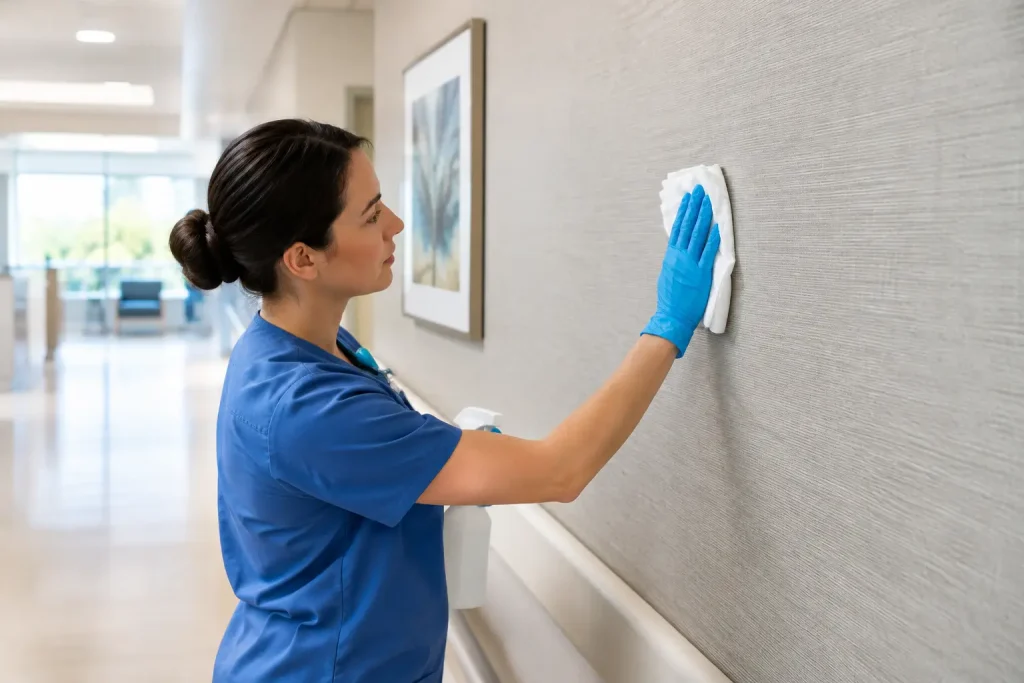
Damage in a hospital corridor tends to follow a pattern. Landor’s hospital wallcovering example points to the first 1.2 metres of the wall as the zone that takes most contact from beds, trolleys, wheelchairs and cleaning equipment. Lift lobbies, reception points, clinic entrances and the areas around handrails also see repeated leaning, touching and wiping.
A liquid coating helps stop that everyday contact turning into permanent marks, and dirt tends to sit on the protective layer rather than being worked into the printed face. It is not a substitute for physical wall protection, though. Crash rails, corner guards and protection panels are there for heavy impacts; the coating is there to protect the image.
Healthcare cleaning regimes vary by area and risk level, and the products used near treatment spaces may be more demanding than those in a public waiting room. Before choosing a coating, ask the estates, facilities or infection prevention team:
Alcohol-based products, quaternary ammonium compounds, hydrogen peroxide formulations and chlorine-based cleaners do not affect coatings in the same way, so a general claim of chemical resistance is not enough. Print, coat and fully cure a sample on the actual wallcovering and ink set, then clean it the way the site will. Look for changes in gloss, colour, softening, haze and edge lift. Our article on whether coatings resist disinfectants covers this test in more detail.

Gloss, satin and matt describe appearance; chemical resistance comes from the coating system and its cure. With that in mind:
For digitally printed wallpaper, Landor’s Wallpaper Matt liquid laminate is a water-based, low-sheen option, with satin and gloss versions also available.
Where the brief calls for it, Landor’s ColourShield anti-microbial coatings are available in gloss, satin, matt and wallpaper matt, and Landor states that they are tested to ISO 22196. An anti-microbial finish is designed to help inhibit the growth of specified bacteria on the coated surface, under the conditions it was tested in.
It does not replace routine cleaning, disinfection or infection-control procedures, and claims should always be tied to the exact coating system and application. Disinfectant resistance is a separate property: a surface may need both. See anti-microbial coatings for the product range.

Film lamination can make a decorative wallcovering feel plastic, alter its texture and leave seams that are harder to keep clean. A liquid laminate forms a clear layer over the print instead of an adhesive film on top of it, which helps keep the natural look of the wallcovering and suits textured surfaces and complex details. It can be applied with coating equipment for consistent production, or by hand for smaller specialist jobs.
Application weight matters: too little gives insufficient protection, too much can affect flexibility and drying. Check the product data sheet for coverage and allow full drying and curing before the wallcovering is rolled, packed or installed. A signed-off sample panel, viewed under the site lighting, is the simplest way to agree colour, sheen and performance with everyone involved.
No coating makes a wall indestructible. A compatible liquid laminate is designed to resist abrasion, moisture, dirt and routine cleaning, which helps the print stay presentable for longer. Heavy impacts from beds and trolleys still need crash rails or wall protection panels.
Landor states that its ColourShield anti-microbial coatings are tested to ISO 22196. They are intended to supplement, not replace, normal cleaning and infection-control procedures.
Gloss and satin are generally the most forgiving in high-contact areas. Matt suits low-reflection designs but needs a gentle, agreed cleaning method to avoid polished patches. Test your chosen finish against the site’s actual cleaning products.
For wallpaper, Landor recommends installing the wallcovering first and then hand-applying Wallpaper Matt over it for the best wipe-clean protection. Work in a ventilated area and allow full cure before the area is cleaned.
Call +44 1252 624411 or email info@liquid-lamination.co.uk for advice, samples and pricing.
