
+44 1252 624411 info@liquid-lamination.co.uk Water-based and UV liquid laminates · Inkjet sprays · Coating machines
Guide
No coating can stop someone tagging a hoarding, shelter panel or lorry curtain. What an anti-graffiti liquid laminate can do is give the print a barrier that lets the mark be cleaned off, so the graphic goes back into service instead of being reprinted. This guide covers how to remove graffiti from coated graphics, which cleaners to use and where the limits lie.
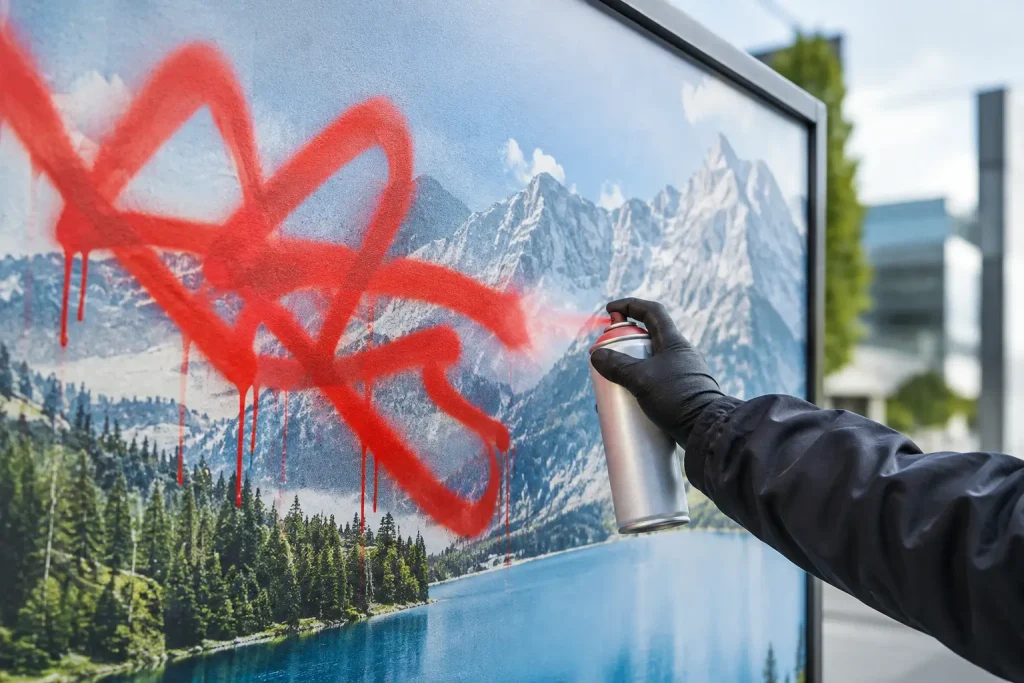
Before reaching for a remover, find out what is on the surface. Results differ a great deal between coating types:
If you do not know which coating was used, treat the surface as standard protection and test any cleaner on a hidden corner first. More background is on our anti-graffiti coatings page.
Some graffiti comes off with plain water; other marks need stronger chemistry. Landor’s anti-graffiti coated surface can be cleaned with a range of solvents or with Landor’s non-petroleum, citrus-based graffiti remover. In a 10-minute spot test reported by Landor, acetone, toluene, gasoline and 5% ammonia showed no effect on the anti-graffiti coating, and it withstood more than 200 double rubs of MEK.
Those results apply to that coating. With so many paints and pens on the market, Landor is clear that it cannot test everything or guarantee results against every marker. Work up from the mildest option:

Remove graffiti as soon as you can, before pigments and resins have time to harden. Then:
Check the result in both direct and raking light. Look for loss of gloss, whitening, colour change, edge lift and any remaining ghost image. On a well-matched system, the gloss level of the protective coating should look the same once the graffiti has gone. Repeated abrasion can dull even a durable coating, particularly on matt finishes.
Fly-posting and stickers leave a different problem: adhesive. On surrounding surfaces, an adhesive remover such as Grafix Gone softens adhesive residue within about 90 seconds and is described as safe on most plastics and latex paint. It is listed among Landor’s application fluids and removers. Before using any remover on a coated print itself, try it on an offcut or an unseen area, as the coating, ink and remover all need to work together.
Some damage cannot be cleaned away. Deep scratches can cut through the coating and ink. Strong solvents, unapproved removers and prolonged contact with certain paints may stain or soften the surface. On heavily textured substrates, contaminants can sit in recesses that are hard to reach without abrasion.
Recoating needs care. Because Landor Anti-Graffiti is formulated to repel as much as it can, including a second coat of itself, it is designed to be applied only once. For a tougher build, Landor suggests a water-based coating as a primer, followed by a single coat of the two-part anti-graffiti coating. If a damaged area cannot be restored, replacement may be the practical answer. Our coating service can coat replacement panels.

The coating is one layer of defence, not the whole answer. Recessing vulnerable panels, improving lighting, using replaceable face panels and keeping graphics away from regular tagging spots can all reduce how often a site is hit. Recording which coating and cleaner were used on each site also makes the next clean quicker and more predictable.
Landor Anti-Graffiti is designed to be applied once, because it repels further coats. For a tougher build, use a water-based coating as a primer first, then one coat of anti-graffiti.
The Landor Anti-Graffiti liquid laminate is available in gloss. Applying Landor’s matt protective coating underneath can soften the gloss, although it does not guarantee a satin or matt result.
Not necessarily. Landor’s tests indicate good protection against solvent and acrylic sprays, paints and marker pens, but it cannot test every product. Test removal on representative panels before a large roll-out.
It can resist some pens and markings, especially in matt or satin, but it is not designed for repeated use of aggressive removers. Specify an anti-graffiti coating where graffiti is a known risk.
Call +44 1252 624411 or email info@liquid-lamination.co.uk for advice, samples and pricing.
