
+44 1252 624411 info@liquid-lamination.co.uk Water-based and UV liquid laminates · Inkjet sprays · Coating machines
Guide
A coated print can feel dry within minutes and still be some way from full performance. Many early failures, from blocking in packaging to marks after the first wipe-down, come from treating touch-dry as finished. This guide explains how the main coating types dry and cure, and what you can control.

Drying is the point at which the liquid has left the film and the surface no longer feels wet. Curing is the longer process by which the coating develops its final hardness, adhesion and chemical resistance. A coating may be dry to the touch quickly, but Landor’s guidance throughout is that it should not be stacked, wrapped, stretched, installed or exposed to cleaning chemicals until it has reached the cure stated for that product.
Judging a coating too early also misleads quality checks. Test panels should be assessed only after they have reached their stated cure.
Water-based laminates such as ClearShield and ColourShield dry by evaporation, using ambient or warm air. They generally take longer to dry than UV-curable coatings and may need more than one coat for maximum protection. For hand-rolled ClearShield Type C, Landor gives about 30 minutes to 1 hour for a thin coat to become touch-dry before the next.
UV coatings cure almost instantly under UV light, which is why they suit high-volume rigid board work. Instant does not mean automatic: lamp output, line speed and coat weight all have to be right, and an under-cured surface can look fine while giving reduced chemical and abrasion resistance. See UV-curable versus water-based coatings.
ClearJet sprays dry quickly; Landor gives roughly 10 to 15 minutes in ambient indoor conditions for ClearJet A2000 and AFA, and up to 15 to 25 minutes for its inkjet sprays generally.

If you need a specific drying or recoat time for your conditions, check the product data sheet or ask Landor rather than guessing.
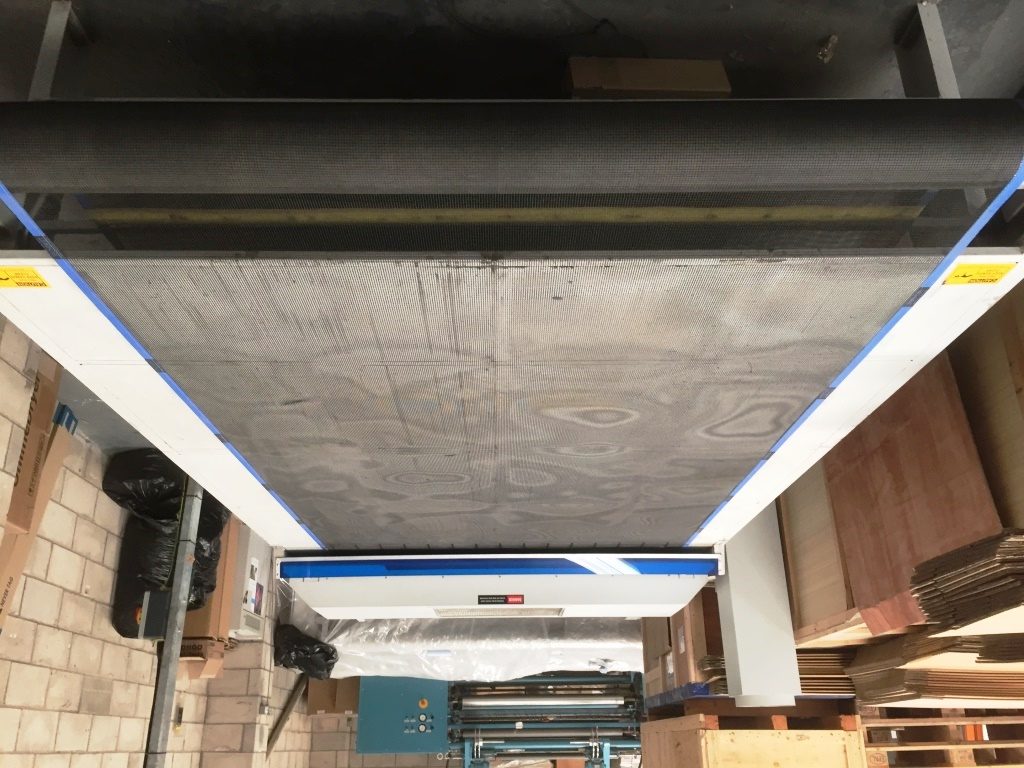
Coating machines control drying as part of the process. Landor’s 1.6m water-based coating system uses an IR heat and air curing system with adjustable heat, speed and fan circulation. Its specification lists a wet coating thickness of 61 to 100 microns giving 25 to 35 microns of dry coating protection. Machine drying makes results more repeatable, but the same rule applies: a coated roll should be fully dry before it is rewound tightly or cut.
Water-based laminates can be shipped in cold weather but must not freeze. If a delivery arrives in cold conditions, store it at ambient temperature and let both coating and substrate acclimatise before use. Stir well, without shaking, so the product is uniform; poorly mixed coating can dry with an uneven sheen.
It depends on product, coat weight, temperature and humidity. For a thin hand-rolled coat of ClearShield Type C, Landor gives about 30 minutes to 1 hour to touch-dry. Full cure takes longer; check the data sheet.
Landor advises curing ClearShield at ideally no lower than 15°C, with better results at around 18°C.
Coating machines such as Landor’s 1.6m system use IR heat and air to accelerate drying. For hand work, keep conditions warm and airy but avoid direct heat and dust. Ask Landor before using heat with a specific product.
Landor recommends leaving the canvas to cure for 24 hours before stretching.
Call +44 1252 624411 or email info@liquid-lamination.co.uk for advice, samples and pricing.
