
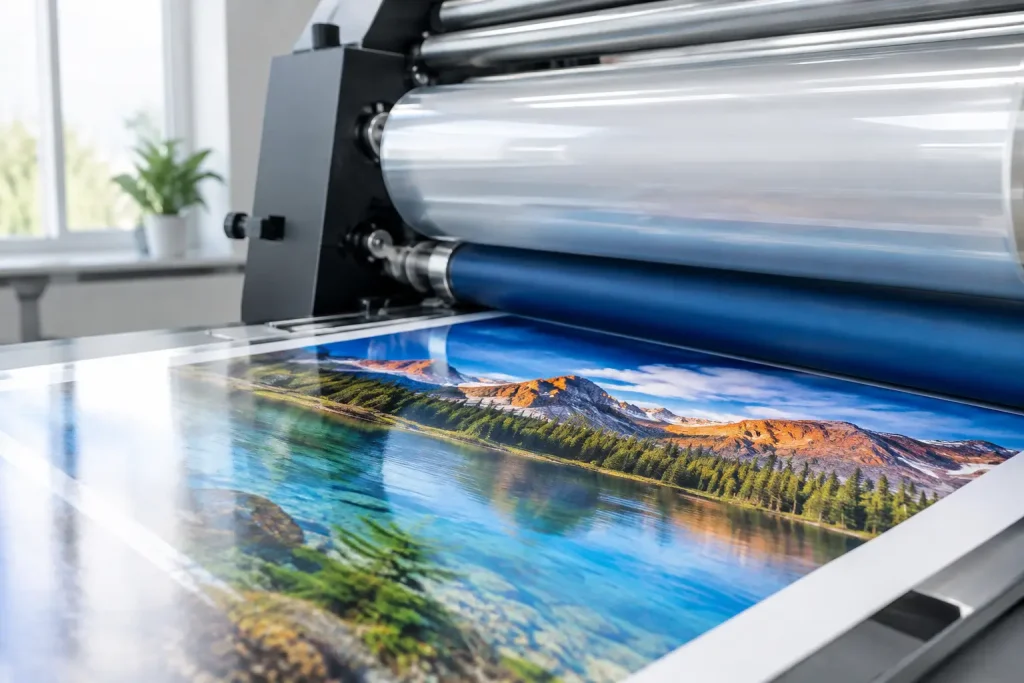
A print can look perfect as it leaves the printer and still fail long before its expected service life. A vehicle graphic may pick up fuel splash and brush wash marks. A wallcovering may be repeatedly cleaned around doorways and reception desks. An exhibition panel may be scuffed during transport before it reaches the stand. This wide format coating guide focuses on preventing those predictable failures without adding a conventional plastic laminate film.
Liquid coating is not simply a finishing step. It is a way to enhance, protect, preserve and extend the value of the printed surface. The right system can improve colour depth and finish while providing resistance to abrasion, moisture, UV exposure, dirt, chemicals and repeated handling. The wrong choice, however, can leave a print under-protected, alter its appearance or slow production unnecessarily.
Start with the real conditions, not the finish
The first question is not whether you need gloss, matt or satin. It is where the graphic will live, how it will be used and what it is likely to encounter.
External signage faces sunlight, rain, airborne pollution and cleaning. Vehicle liveries must tolerate road grime, wash cycles, fuel residues and physical contact. Retail graphics, public displays and digital wallpaper have a different problem: concentrated wear from hands, bags, trolleys and frequent cleaning. Fine-art reproductions may need subtle surface protection that retains the character of the image rather than creating a highly reflective finish.
Define the risks before specifying the coating. Consider the likely lifespan, whether the print is installed indoors or outdoors, the substrate and ink technology, the expected cleaning regime, and whether the surface will be touched frequently. This assessment avoids a common and costly mistake: choosing a coating principally for its appearance and discovering later that it does not have the required resistance.
Wide format coating guide: choose the right chemistry
Water-based and UV-curable liquid coatings can both protect wide-format graphics, but they suit different workflows and performance demands.
Water-based liquid coatings
Water-based liquid laminates are a practical alternative where conventional films are unsuitable, difficult to apply or environmentally undesirable. They can be applied across a broad range of digitally printed graphics and substrates, creating a flexible protective layer without the extra plastic film and adhesive layer associated with traditional lamination.
For many signmakers, print producers and installers, water-based systems are an effective choice for posters, point-of-sale graphics, wallcoverings, canvas, vehicle graphics and short-to-medium-run work. They are especially valuable where a coated finish is needed on textured, uneven or non-standard surfaces that do not laminate easily.
Drying and curing conditions matter. Coating weight, humidity, temperature, ink coverage and substrate porosity all affect dry time and finish development. A coating line should be set up around controlled application and adequate drying space, not treated as an afterthought at the end of production.
UV-curable coatings
UV-curable systems cure rapidly under the correct UV energy, making them well suited to higher-volume production and demanding industrial display applications. Their speed can reduce handling time and support efficient finishing where throughput is critical.
These systems may also provide strong surface performance for applications exposed to repeated handling, abrasion or chemical contact. However, the equipment investment, curing set-up and substrate compatibility need careful evaluation. A fast process is only commercially useful when the coating is applied evenly and cured fully across the entire width of the print.
The choice is not simply water-based versus UV. It depends on the image, substrate, intended durability, available equipment, production volume and the finish the customer expects.
Match the finish to the graphic’s job
Gloss coatings enhance colour saturation and perceived depth. They are often specified for promotional displays, photographic graphics and vehicle work where visual impact is a priority. The trade-off is that gloss can reveal reflections and surface imperfections in strongly lit interiors.
Matt coatings reduce glare and can give wall graphics, fine-art prints and interior displays a more refined appearance. They are useful in retail, gallery and office settings where viewers stand close to the image. Matt finishes need a system designed to retain cleanability, because some low-sheen surfaces can show marks if they are not properly protected.
Satin sits between the two, offering improved colour and a lower-reflection surface. It is frequently the sensible choice when a client wants a premium finish without the full shine of gloss or the very flat appearance of matt.
Finish must never be separated from performance. A hospital corridor wall graphic, for example, may need a low-glare appearance but also reliable resistance to routine cleaning and an appropriate anti-microbial coating specification. A lorry curtain graphic needs flexibility as well as weather and abrasion resistance. The surface appearance is only one part of the decision.
Prepare properly before coating
Liquid coating will not correct poor print quality, unstable ink adhesion or contamination on the surface. Allow ink to dry and outgas in line with the ink and media supplier’s recommendations before applying a coating. Rushing this stage can affect adhesion, appearance and long-term performance.
The print should be clean, dry and free from dust, silicone, grease and application residues. Check that the coating is compatible with the specific ink set and substrate, particularly with latex, solvent, eco-solvent and UV ink systems. A small controlled test is sensible whenever a new media, ink or coating combination enters production.
Application consistency is equally important. An uneven wet film can produce streaking, pooling, inconsistent gloss or reduced protection. Use the correct coater, roller, spray system or other application method for the format and workload. Maintain equipment carefully and measure coating use, because excessive application adds cost and can increase drying time without improving results.
Specify protection for the failure mode
A broad claim of “durable” is not enough when a graphic has a demanding job. Specify the protection required in practical terms.
For externally installed graphics, UV resistance and water resistance are fundamental, alongside protection from dirt and pollution. For fleet graphics and vehicle wraps, add flexibility, abrasion resistance and resistance to wash chemicals. In busy interiors, focus on scuff resistance and the ability to withstand repeated cleaning. Public-facing surfaces may benefit from anti-graffiti protection so marks can be removed without sacrificing the graphic beneath.
Healthcare, education, hospitality and leisure environments can require further consideration. High-touch printed surfaces may need an anti-microbial coating solution as part of the broader hygiene strategy. This should be selected with clear expectations: coatings can support surface protection, but cleaning protocols and the wider environment still matter.
For fine-art and giclée production, the priority may be preserving image detail, colour character and the intended surface texture. The strongest or glossiest coating is not automatically the best option. Test for visual change under gallery lighting and allow samples to cure fully before client approval.
Reduce waste by designing for service life
Conventional laminate films can create challenges at the point of application and end of life, particularly on large, complex or textured graphics. Liquid alternatives can reduce material layers while protecting the print, helping producers avoid premature replacement caused by scratches, fading or cleaning damage.
The environmental benefit is closely connected to commercial sense. A graphic that remains presentable for its required life is less likely to be reprinted, reinstalled and disposed of early. That saves media, ink, labour, transport and disruption for the customer.
This does not mean every application needs the highest-specification coating. Over-specifying adds unnecessary cost and processing. A short-term indoor promotion has different needs from a station wallcovering or an external vehicle fleet. Specify proportionately, then protect the print properly for the environment it will face.
Build coating into the production conversation
The best time to discuss protection is when the job is quoted, not after the customer reports scuffs or fading. Ask how long the graphic must perform, where it will be installed, how it will be cleaned and whether it is likely to face touch, transport or vandalism.
Provide a coated sample where appearance is critical. It turns an abstract finish decision into something the customer can see and handle. For regular production, record the approved substrate, ink, coating, application method and cure conditions. That simple discipline makes repeat orders more reliable and helps diagnose issues quickly.
Landor Liquid Lamination supports this application-led approach with liquid coating systems, machinery, starter kits, demonstrations and technical guidance for producers working across graphics, décor, vehicles and specialist print.
Protecting a wide-format print is ultimately about respecting the conditions it must survive. Specify the coating around the real risk, validate it on the actual print combination and give every finished graphic the service life it was sold to deliver.
