
+44 1252 624411 info@liquid-lamination.co.uk Water-based and UV liquid laminates · Inkjet sprays · Coating machines
Guide
Stretching is where many canvas prints are damaged. As the canvas is pulled around the frame, ink on the high points of the weave can crack, especially at the edges. Landor recommends coating canvas with a canvas liquid laminate before it goes on the stretcher, then leaving it to cure, so the coating can flex with the canvas rather than fight it.

Landor’s canvas coatings are formulated to move with the canvas when it is stretched over a frame, helping to prevent the ink cracking on the textured weave. They also protect against moisture, pollution and UV fade, and let dirt and dust be wiped away later. Coating the canvas flat has practical advantages too:
The Landor FAQ puts it simply: coat with a canvas liquid laminate before stretching, and leave the canvas to cure for 24 hours before it goes on the frame.
Landor’s water-based canvas coatings are designed for water-resistant canvas and work best with pigmented inks. They are formulated for microporous and porous inkjet-receptive layers and are designed to reduce the pinholes that can appear when coating water-resistant inkjet canvas. ClearShield and ColourShield suit water-resistant substrates printed with pigmented aqueous, eco-solvent, latex and UV inks.
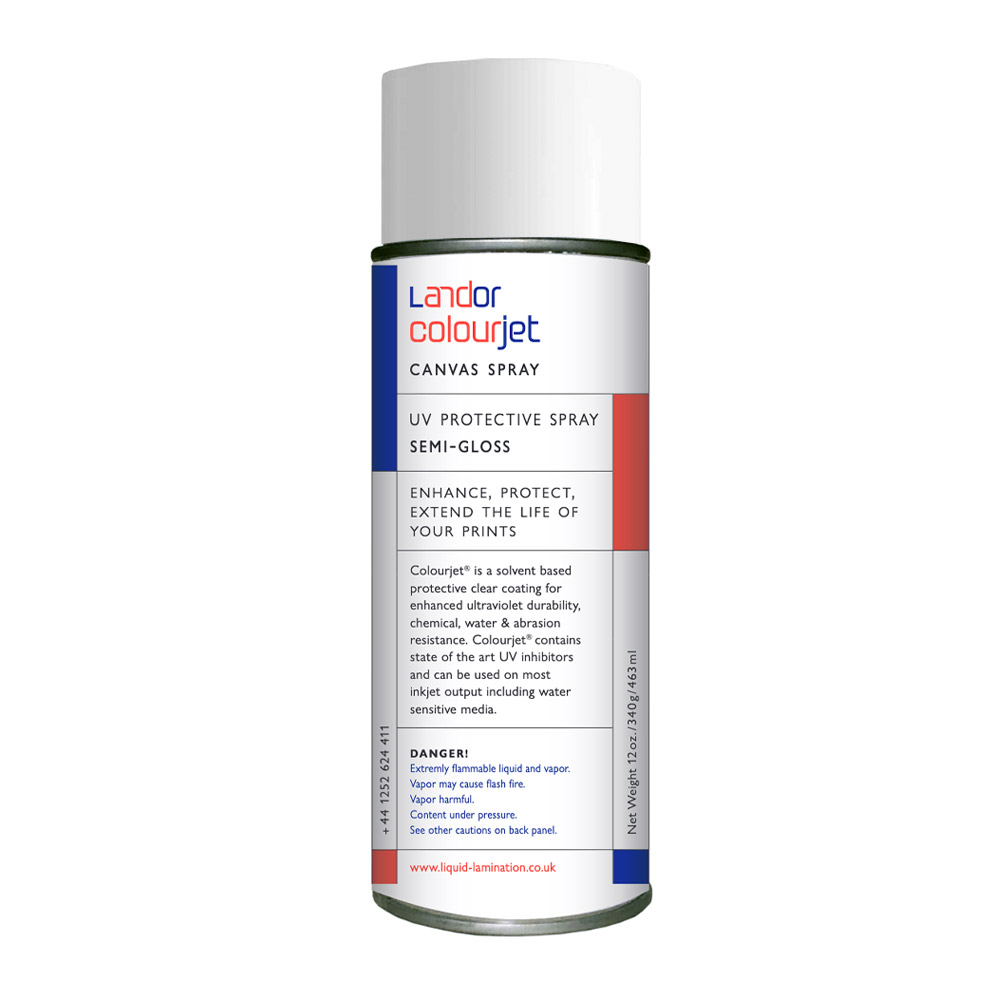
If the canvas is water-sensitive, or the print uses dye-based inks, Landor directs users to its solvent-based ClearJet AFA coatings instead. For small jobs, ClearJet Fine Art (FA) and ColourJet Canvas are available as ready-to-use aerosols with no clean-up. Canvas coatings come in gloss, satin and matt. Full product details are on the canvas and fine art page.
Make sure the print is fully dry and has had time to outgas, then work in a clean, dust-free area. Landor’s instructions for ClearShield Type C on canvas give a good working method:
Two thin coats give a better-looking finish than one saturated coat. Working in one direction and then across, in a cross-hatch pattern, helps ensure even coverage, and with enough fluid the coating levels as the roller lifts off. Our guide to applying liquid laminate with a roller covers technique in more depth.

The edges that wrap around the stretcher bar take the most strain. Coating them improves resistance to handling during stretching and framing, but the build must be even. A thick ridge of coating at the edge can crack when folded around the bar or leave a glossy band. Spread coating out to the edges rather than letting it pool there.
Touch-dry is not the same as ready to stretch. Stretching too early can mark a soft coating at the bar edge, create tension lines or cause blocking where coated surfaces touch. Landor recommends leaving canvas to cure for 24 hours before stretching. While it cures, keep it flat, or upright with space between pieces, away from heat, cold, humidity and dust.
When you do stretch, use balanced tension. Pulling one side very hard before working round the frame can distort the weave and put extra stress on the coating. Handle the canvas by the unprinted margins with clean hands or gloves.
Sometimes. For some editions, coating after stretching gives better edge coverage or suits the workflow, and there is no universal rule. If you do coat a stretched canvas, make sure the frame is rigid and the canvas evenly tensioned so it does not move under the roller, and protect the back and sides. For prints that have already been framed without protection, Landor’s coating service can advise on the options.
Landor recommends leaving coated canvas to cure for 24 hours before stretching. Check the data sheet for the specific product you are using.
Landor’s water-based canvas coatings are for water-resistant canvas and work best with pigmented inks. For dye-based inks or water-sensitive canvas, Landor recommends its ClearJet AFA solvent coatings.
With enough fluid on the roller, the coating levels as the roller leaves the surface. Keep a wet edge, avoid going back over areas that have started to dry, and use two thin coats rather than one heavy one.
Landor canvas coatings come in gloss, satin and matt. Gloss deepens colour, matt reduces glare, and satin sits between the two. Test on an offcut printed at the same time.
Call +44 1252 624411 or email info@liquid-lamination.co.uk for advice, samples and pricing.
