
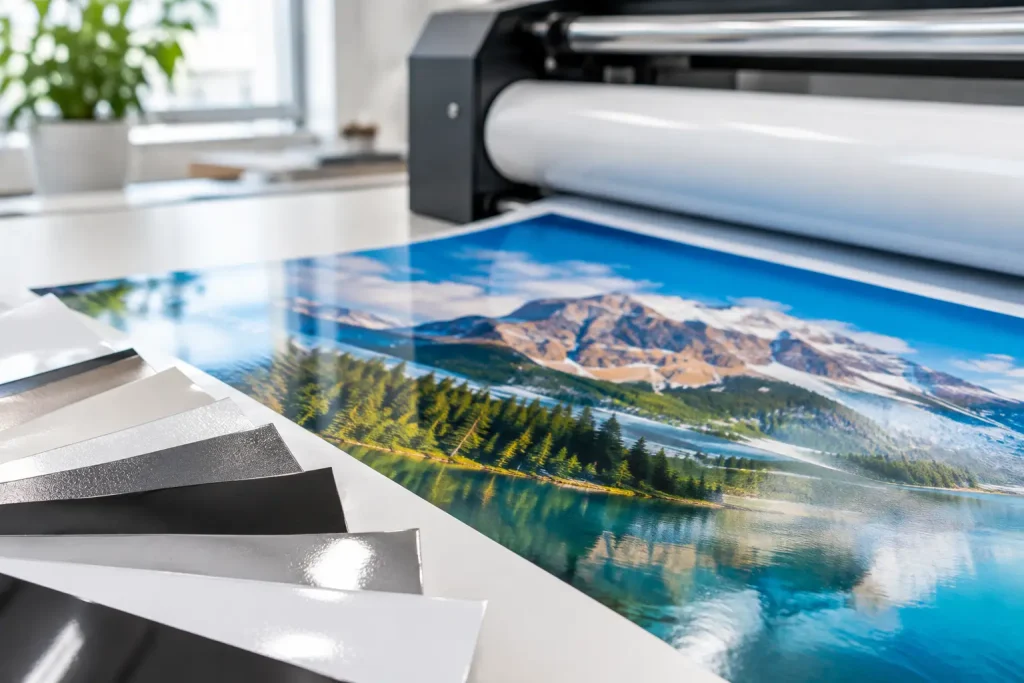
A printed vehicle livery can leave the workshop looking flawless, then lose its impact after a few weeks of road grime, wash chemicals and repeated handling. A wall graphic may be visually perfect until chair backs, bags and routine cleaning start to mark the surface. This wide-format coating selection guide starts with that reality: the right finish is not simply a gloss, matt or satin preference. It is a protection decision shaped by where the graphic will live, how it will be used and what failure would cost.
Liquid coatings give print producers a practical alternative where film laminates are unsuitable, inefficient or likely to compromise the finished application. They can enhance colour and surface appearance while helping preserve the print against abrasion, moisture, UV exposure, chemicals, dirt and high-touch wear. However, coating selection must begin with the application, not the product tin.
Start with the real-life risks to the graphic
Every wide-format job has an exposure profile. A short-term indoor exhibition panel faces very different pressures from a shopfront graphic, a lorry curtain or digitally printed wallpaper in a healthcare corridor. Before choosing a coating system, establish whether the printed surface will be exposed to sunlight, rain, cleaning chemicals, physical abrasion, repeated contact, vehicle wash regimes, pollution or possible graffiti.
Outdoor graphics need a coating that supports long-term resistance to weathering and UV fading. This matters especially where a print has been produced with inks or media that perform well visually but need added surface protection to withstand prolonged exposure. Vehicle graphics need more than weather resistance. They must cope with grit, fuel residues, wash chemicals, flexing substrates and the scuffs of daily transport use.
For interiors, the pressure is often more mechanical than climatic. Retail graphics, public displays and wallpaper can receive thousands of touches, knocks and cleaning cycles. A protective coating should preserve the printed image without making the surface look overly plastic or altering its intended tactile quality. In sensitive sites such as healthcare, education and public venues, anti-microbial performance may also form part of the specification.
Match the coating to the substrate and ink
A coating cannot be selected in isolation from the print process. The ink chemistry, substrate surface, flexibility requirements and curing conditions all affect adhesion and final appearance. PVC vinyl, self-adhesive films, banner materials, canvas, textiles, wallcoverings, rigid boards and paper-based prints do not behave in the same way under a coating.
Flexible media require a coating film that can move with the substrate. On vehicle wraps and lorry curtains, a brittle coating can crack or lose its appearance at stressed points, particularly around contours, folds and areas subject to constant movement. Rigid boards may allow a different approach, but the coating still needs to bond consistently and withstand the cleaning or handling expected in use.
Ink must also be properly cured or dried before coating. Residual solvent, incomplete curing or unsuitable ink/coating combinations can cause adhesion problems, cloudiness or an uneven finish. This is why production trials matter. A small test panel can reveal whether the coating wets out evenly, whether colour density changes and whether the surface retains the flexibility or texture the job requires.
For fine-art reproductions, giclée editions and canvas prints, the priority may be preserving colour depth while providing protection that does not overwhelm the image. The chosen finish should support the artist’s intended appearance, whether that means a low-sheen surface, deeper blacks or a more pronounced canvas texture. The most protective coating is not automatically the best choice if it visibly changes the work.
Choose the finish for appearance and function
Gloss, satin and matt finishes are commercial as well as aesthetic choices. Gloss can intensify colour, deepen blacks and create a high-impact surface for point-of-sale graphics, photographic prints and vehicle liveries. It can also show reflections, fingerprints and surface imperfections more readily. That trade-off may be acceptable in a bright retail environment but less suitable for a display viewed under strong directional lighting.
Matt coatings reduce glare and can create a refined finish for wallcoverings, museum-style graphics and interior displays. The surface must still be specified for the expected level of wear: a matt finish should not mean accepting a fragile one. Satin sits between the two, offering reduced reflection while retaining colour enhancement and a practical, cleanable surface.
Texture is another consideration. On wallpaper or canvas, the coating should protect without filling in the character that gives the print its value. On smooth signage, the objective is usually an even, consistent film that improves cleanability and leaves no visible application marks. Application method, coating viscosity and drying or curing control are central to achieving that result.
Water-based or UV-curable: select for the production route
Water-based liquid coatings are often a strong choice where low odour, practical handling and sustainability are priorities. They provide effective protection for many graphics, signs, wallcoverings and fine-art applications, while avoiding the material use associated with conventional plastic laminate films. They can be applied by roller, spray or suitable coating equipment, depending on the job and required finish.
UV-curable coating systems suit production environments that need immediate curing and high throughput. Once cured, they can offer a durable protective layer with excellent resistance properties, making them particularly relevant for demanding industrial display, signage and volume print applications. The equipment investment and process control required may be greater, so the best choice depends on throughput, substrate range, available floor space and the value of faster turnaround.
Neither route is universally superior. A studio hand-coating selected giclée prints has different needs from a graphics manufacturer processing large volumes of rigid panels. The key is to assess the entire workflow: print curing time, coating application, drying or UV curing, handling, packing and installation. A coating that performs well but slows down a critical production stage may not be the most commercially effective system.
Specify for cleaning, graffiti and high-touch use
Many graphics fail long before the ink fades because the surface is cleaned incorrectly or too aggressively. If a printed asset will be wiped regularly, identify the actual cleaning products used on site. Mild detergent, alcohol-based cleaner, disinfectant and specialist graffiti remover place very different demands on the coating film.
Anti-graffiti protection is particularly valuable on public-facing signage, transport-related graphics, retail displays and exterior surfaces vulnerable to vandalism. The specification should consider not only whether marks can be removed, but how many cleaning cycles the surface must tolerate without losing gloss, colour or coating integrity.
For high-touch environments, anti-microbial coatings can support hygiene-led specifications on printed wallcoverings, displays and information graphics. They should be selected as part of a wider cleaning and maintenance regime, not presented as a substitute for it. The practical objective is a surface that remains visually credible and easier to maintain throughout its service life.
Build application into the coating decision
A good coating can underperform if it is applied inconsistently. Roller application can be effective for certain substrates and lower-volume work, while spray systems provide control on shaped items, large graphics and surfaces where an even film build is essential. Automated or purpose-built coating machinery may offer the repeatability that production teams handling regular volumes need.
Film weight matters. Too little coating may leave the print insufficiently protected; too much can affect flexibility, drying time, texture or cost per square metre. Operators need clear guidance on coverage rates, drying conditions, cure times and handling. Dust control is equally important, as contamination can turn an otherwise excellent finish into a rejected panel.
Landor Liquid Lamination supports this application-led approach through specialist coating systems, equipment, demonstrations and technical advice. Testing a customer’s actual print, substrate and intended use is often the fastest way to protect margin before a full production run.
Use service life to judge value
The cheapest finishing option at the point of production is not always the lowest-cost option over the life of the graphic. Reprints, reinstallations, client complaints and downtime quickly outweigh a modest investment in suitable protection. A coating that extends the usable life of a retail graphic, fleet livery or wallcovering can reduce material waste while keeping the visual asset working for longer.
Specify the coating alongside the expected service life, environment and maintenance plan. Ask what will touch the surface, what will clean it and what happens when it faces its worst day rather than its best. That is where a well-chosen liquid coating earns its place: preserving the image, protecting the investment and giving the finished graphic a longer, more dependable working life.
