
+44 1252 624411 info@liquid-lamination.co.uk Water-based and UV liquid laminates · Inkjet sprays · Coating machines
Applications
Graphics on boats, pontoons and waterside structures sit in one of the harshest settings a print can face: constant moisture, strong reflected sunlight and awkward surfaces to install on. A clear liquid coating over the printed vinyl is one way to help the image hold up for longer. Landor’s best-documented marine project is a large one, and it shows both what a coating can contribute and why testing comes first.
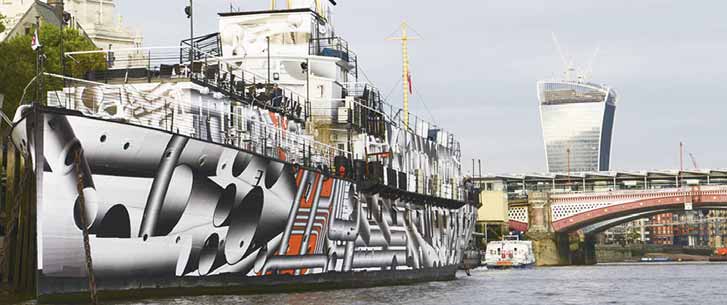
To mark the centenary of the First World War, 14-18 NOW commissioned digital print specialists PressOn to wrap the former Royal Navy ship HMS President in dazzle-print camouflage designed by artist Tobias Rehberger. The ship is berthed by Victoria Embankment on the Thames.
The job involved printing 2,000 sq. m of polymeric multi-fix vinyl. Because the print had to cope with the Thames-side environment, PressOn chose a Landor protective coating, which it reported significantly increased print durability and UV resistance. Installation was dictated by the tides: a small vessel circled the ship at low tide so installers could fit, heat and smooth the vinyl across the irregular hull. Twelve installers took 10 days to finish. The full story is in ClearShield Naval Protection.
Most of the threats to a marine graphic are the same ones Landor describes for any outdoor print, only more intense:
A clear coating does not make a graphic indestructible, but it adds a barrier between these factors and the ink. Landor’s published material does not give specific ratings for continuous immersion or salt spray, so treat any graphic that will sit below or near the waterline as a case for testing and technical advice rather than assumption.

Marine graphics are usually printed vinyl applied to fibreglass, painted metal or timber. ClearShield water-based liquid laminate is designed for water-resistant ink and media combinations, including solvent, eco-solvent, latex and UV inks, and is listed for use on vinyl, fibreglass, wood, metal and plastic. It contains UV inhibitors, is described as non-yellowing and highly flexible, and has good exterior durability.
Flexibility matters on a hull, where vinyl is stretched over curves and contours. A liquid coating moves with the substrate instead of acting as a second film that can lift at the edges. Where the print uses water-sensitive inks, a solvent-based coating such as ColourJet is the alternative, used with good ventilation. On difficult surfaces, Landor can advise whether a primer or a coating doubling as a primer is needed to improve adhesion.
Where possible, coat the printed vinyl flat, before installation, once the print has dried fully. This gives better control over coat weight and keeps dust and moisture out of the wet coating. Liquid laminates can also be applied to graphics that are already installed, provided the surface is clean and dry, which can be useful for refreshing an existing livery.
For the installation itself, Landor’s vinyl application fluids are designed to help position pressure-sensitive vinyl: Splash wets the surface so large graphics can slide into place, and ActionTac is a ready-to-use fluid for most grades of vinyl. Landor also advises scheduling application of adhesive graphics for cooler parts of the day where possible, as self-adhesive vinyl softens in heat and hardens in cold.
Every marine project combines a particular vinyl, ink, coating and surface, so a representative sample is the most reliable guide. Coat an offcut of the production vinyl, let it cure as the product data sheet specifies, and check adhesion, flexibility and appearance before committing to the whole vessel. Landor will test printed samples and can recommend a finish; gloss is generally the choice where abrasion resistance matters most.
Landor’s published information does not cover continuous immersion. Discuss any below-waterline or splash-zone graphic with Landor before specifying a coating, and test a sample under realistic conditions.
Gloss gives the strongest colour enhancement and, according to Landor, the best abrasion resistance. Satin and matt are available where reflection off the hull would be distracting.
No. Liquid laminates can be applied by hand roller, brush, paint pad or spray. Machines help with consistency and volume, but they are not required.
Call +44 1252 624411 or email info@liquid-lamination.co.uk for advice, samples and pricing.
