
A scuffed vehicle graphic, a lifting edge on a wallcovering or a dulled fine-art print all create the same costly problem: the image no longer represents the quality of the work behind it. When considering liquid coatings versus laminate films, the right decision is not simply about gloss, matt or price per square metre. It is about how the finished print will be handled, cleaned, exposed and expected to perform.
Film laminates remain familiar across wide-format production, and for certain jobs they are an appropriate choice. Yet water-based and UV-curable liquid coatings offer a practical alternative where film is difficult to apply, visually intrusive, environmentally undesirable or simply unable to suit the shape, surface or performance requirement. The best finishing method starts with the risks the print will face after it leaves the press.
Liquid Coatings Versus Laminate Films: The Core Difference
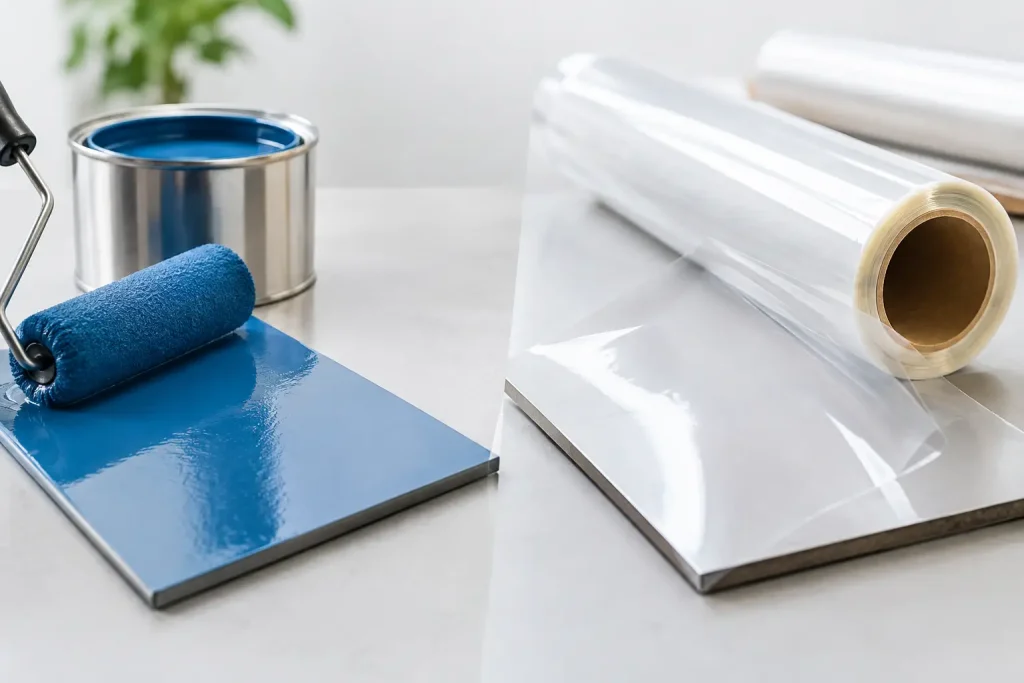
A laminate film is a pre-made plastic layer, usually supplied on a roll with an adhesive. It is applied over a print using a laminator, pressure and careful handling. The film becomes a physical barrier between the printed surface and abrasion, moisture, dirt and UV exposure.
A liquid coating is applied as a fluid by roller, spray or coating machine, then dries or cures to form a protective surface. Depending on the system, it may be water-based or UV-curable. This changes the production process but, more significantly, it allows the protection to conform directly to the print, substrate and application rather than adding a separate adhesive-backed sheet.
Neither option is automatically better. Film can provide a familiar, substantial protective layer and may suit straightforward flat-panel work where equipment and workflow are already established. Liquid coatings come into their own when the job demands flexibility, edge-to-edge protection, controlled surface finish, reduced plastic use or reliable treatment of difficult materials.
Where Film Lamination Can Create Problems
Adhesive films have to be handled, aligned and bonded successfully. On large prints, rushed finishing, dust contamination, uneven pressure or poor storage conditions can lead to silvering, bubbles, wrinkles and visible application marks. Any failure at the edge creates a route for dirt and moisture to enter.
This matters particularly on graphics exposed to frequent washing, transport wear and high-touch use. Vehicle liveries, lorry curtains, public information graphics and retail displays are regularly subjected to abrasion, cleaning chemicals and repeated contact. If film edges begin to lift, the visual asset can quickly look tired, even if the print beneath remains intact.
Films can also alter the character of the image. A highly textured, fine-art or canvas surface may lose some of its intended appearance beneath a plastic layer. On digitally printed wallpaper, joins, corners and installation details require close attention. Some films are unsuitable for irregular surfaces, shaped objects or substrates that need to flex significantly in service.
There is also a material consideration. Conventional laminate films introduce additional plastic and adhesive into the finishing process. Where a client is actively reducing plastic use, or where disposal and waste are under scrutiny, a liquid alternative deserves proper evaluation rather than being treated as an afterthought.
What Liquid Coatings Add to the Finishing Process
A correctly selected liquid coating protects without the separate film-and-adhesive layer. It can be applied across the full image area, including places where a film edge would otherwise be vulnerable. The coating can enhance colour density and perceived contrast, while a matt, satin or gloss finish can be selected to support the intended appearance of the graphic.
For print businesses, this is not only an aesthetic advantage. With the right equipment, it can simplify finishing on large, awkward or high-volume jobs. Rollers and automated coating machinery support repeatable application, while spray coatings can be useful for specialist pieces, uneven surfaces and selected production environments.
Water-based systems are particularly relevant for businesses seeking a lower-impact process with less reliance on plastic laminate films. UV-curable systems offer fast curing and can support demanding production schedules where immediate handling is required. The right choice depends on substrate, ink set, print volume, desired finish and the environment in which the finished graphic will be used.
Liquid coatings are not limited to basic surface protection. Specialist formulations can be selected for anti-graffiti performance, anti-microbial requirements, chemical resistance, added flexibility or enhanced durability in harsh outdoor conditions. This makes finishing a functional part of the specification, rather than a final production step that receives attention only when something fails.
Appearance and print fidelity
A coating should preserve the creative intent of the print. For photographic wall graphics, retail visuals and giclée editions, the finish must support the image rather than mask it. A matt coating can reduce distracting reflections in brightly lit interiors; a gloss finish can increase visual depth and colour vibrancy; satin provides a controlled middle ground.
The key is testing. Ink, media, profile, coating and application method operate as a system. A finish that looks excellent on one vinyl, paper or canvas may need adjusting on another. Test panels are a sensible safeguard before committing a premium artwork, national roll-out or vehicle fleet programme.
Durability in the real world
Protection claims only matter when they relate to actual use. External signage faces UV light, rain, pollution and temperature changes. Indoor graphics in hospitals, schools, venues and retail spaces face finger marks, cleaning regimes and constant contact. Vehicle graphics encounter road grime, fuel splashes, mechanical abrasion and repeated washing.
A liquid coating can be specified to address these conditions directly. The result is a printed surface better able to resist scuffs, moisture, dirt, chemical exposure and fading, helping to extend replacement cycles. That is commercially meaningful for both the print supplier and the end user: fewer premature replacements, fewer complaints and a visual asset that continues to look fit for purpose.
Choosing by Application, Not Habit
The most useful question is not “Do we normally laminate this?” but “What will cause this print to fail?” That reframes the selection process around performance.
For vehicle wraps and fleet graphics, flexibility and resistance to road wear, washing and UV exposure are central. Film may suit some established wrap workflows, but liquid protection can avoid edge-related concerns and can be valuable on printed areas where a conventional overlaminate is impractical. Compatibility with the chosen vinyl, ink and expected vehicle use must be assessed first.
For wallcoverings, the decision often centres on appearance, cleanability and installation practicality. A coating can help protect digitally printed wallpaper in corridors, hospitality spaces, healthcare settings and public interiors without adding a separate plastic face film. Where hygiene is a priority, an anti-microbial coating system may be part of the wider surface-protection strategy.
For fine art and canvas, the aim is to protect the edition while retaining the texture and tonal subtlety that make the image valuable. A suitable liquid coating can provide a carefully controlled finish and improve resistance to handling, dust and light exposure. Application technique is crucial here, as the coating must be even and sympathetic to the substrate.
For external signage and display graphics, assess the exposure period, cleaning method, mounting method and likelihood of vandalism. A standard protective finish may be sufficient for a short campaign; a more specialised anti-graffiti or high-durability system may be justified for permanent public-facing installations.
Cost Should Include Replacement Risk
Comparing only the purchase price of film against coating can be misleading. Film brings material, adhesive, wastage, storage and application labour into the calculation. Liquid coatings bring their own consumables, equipment, curing or drying and training requirements. A more accurate comparison includes reprints, reinstallation, downtime and the cost of a graphic that deteriorates before its planned replacement date.
For smaller studios, starter kits and guided application can make liquid finishing accessible without a major capital commitment. For larger print operations, dedicated coating machinery can support consistency, speed and less handling across repeatable work. Technical guidance is valuable at both ends of the scale because successful results rely on matching the chemistry and application method to the job.
Landor Liquid Lamination works from this application-led approach: identify the environmental and handling risks first, then specify the coating system and finish that will protect the print without compromising its purpose.
A Better Question to Ask Before Finishing
Laminate film is not obsolete, and liquid coating is not a universal substitute. Some projects favour the familiar physical barrier of film, particularly where it is proven compatible with the substrate and the graphic is flat, accessible and suited to the existing workflow. Other projects need the flexibility, surface conformity, finish control and reduced-plastic approach that liquid systems provide.
Before the next print goes to finishing, consider where it will be touched, cleaned, bent, transported, exposed to sunlight or challenged by the public. That is where the right protective coating earns its place: not as an optional extra, but as the measure that helps the image keep doing its job.
