
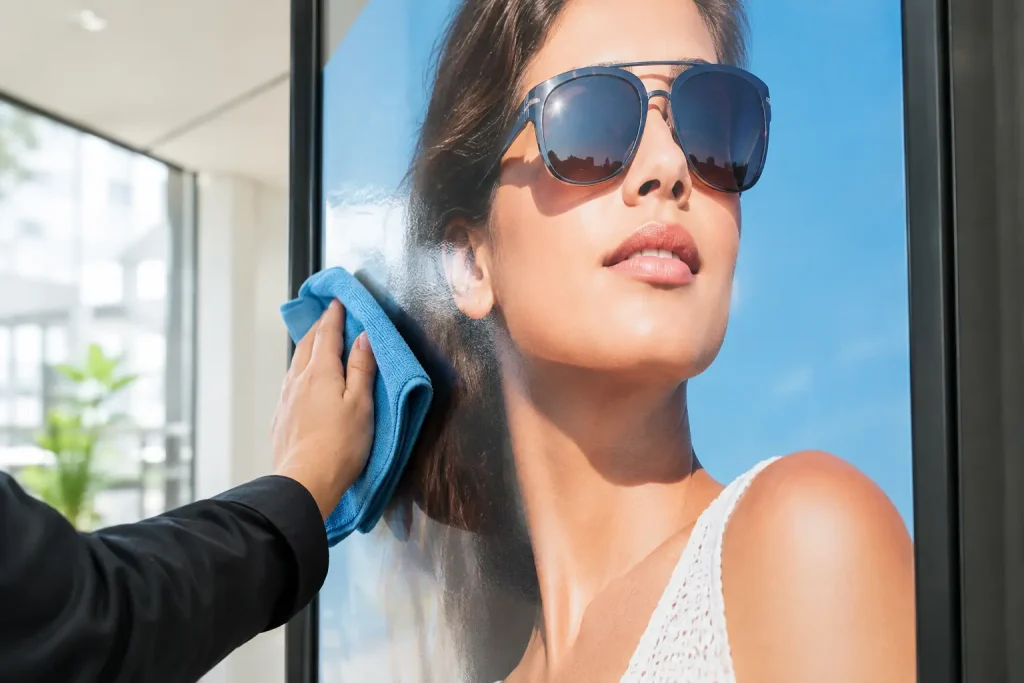
A retail graphic can look immaculate when it leaves the print room and tired within a week on site. Aisle-end displays are brushed by baskets, window campaigns face sunlight, wall graphics are cleaned repeatedly, and point-of-sale panels collect fingerprints from opening until close. Selecting the best coatings for retail graphics is therefore not simply a question of gloss versus matt. It is a decision about where the graphic will live, how it will be handled and what failure would cost the customer.
For print businesses and signmakers, the right liquid coating can preserve colour, improve surface feel and extend the useful life of a campaign without adding a conventional plastic film. The wrong choice can flatten an intended finish, reveal roller texture, reduce flexibility or fail prematurely under cleaning and abrasion. Start with the risks, then match the coating system to the application.
Why retail graphics fail sooner than expected
Retail is a demanding environment because it combines several forms of wear at once. Printed graphics may be moved through a warehouse, installed overnight, cleaned by facilities teams and touched by thousands of shoppers. Even short-term promotions are not necessarily low-risk: a four-week launch beside an entrance can take more punishment than a long-term graphic in a quiet office.
Abrasion is usually the first visible problem. Scuffs on display panels, rubbing on hanging signage and friction around fixtures can dull the print surface or mark dense colours. Moisture, airborne pollution and UV exposure add further pressure on window graphics, external fascia panels and graphics near open entrances. Cleaning introduces another variable. If a site uses frequent wipe-down routines, the coating must tolerate the specified cleaning regime rather than merely look good at installation.
This is why a coating should be chosen as part of the production specification, not as a finishing afterthought. The substrate, ink set, print cure, intended finish, installation method and cleaning chemicals all matter.
Best coatings for retail graphics: choose by use case
There is no single best finish for every shop-floor graphic. A water-based liquid laminate may be the sensible choice for a flexible, lower-impact workflow, while a UV-curable system can suit controlled, higher-volume production where immediate curing and throughput are priorities. The correct answer depends on the graphic’s exposure and the production environment.
High-touch point-of-sale and display panels
Counter units, shelf-talkers, product pedestals and display boards benefit from a coating that resists repeated contact and everyday scuffing. Satin and matt finishes are often preferred where reflections from retail lighting would distract from the message, while gloss can add visual depth to product photography and high-impact promotional imagery.
Do not select a finish on appearance alone. A very matt surface can be harder to keep pristine in some high-contact settings, particularly where oily fingerprints are likely. Test the printed substrate and chosen finish under realistic handling, cleaning and transport conditions. A small production proof costs far less than replacing a full campaign after installation.
Window graphics and entrance campaigns
Retail windows must compete with daylight, changing weather and the visual noise of the high street. For printed window graphics and externally facing promotional panels, UV resistance and water resistance are central requirements. The coating also needs to maintain the intended colour and clarity without undermining the adhesive, film or installation process.
Consider whether the graphic is viewed through glass, applied externally or positioned inside but exposed to strong sunlight. These are different conditions. A short seasonal campaign may justify a different system from a flagship store installation expected to remain in place for months. Always allow proper drying or curing before packing, transport and fitting, especially where graphics may be stacked or rolled.
Wallcoverings, murals and changing-room graphics
Retail wall graphics can be vulnerable to trolley knocks, bags, footwear and routine cleaning at hand height. They also present a finish challenge: the coating must protect the ink without making a textured or matt wallcovering look unnaturally glossy.
Water-based liquid coatings are particularly useful where preserving the character of the substrate matters and where conventional laminate films are unsuitable for textured, embossed or irregular surfaces. The coating should conform to the surface rather than bridge across it. For digitally printed wallpaper, test adhesion, finish uniformity and the effect on joins before committing to volume.
In fitting rooms, beauty halls and children’s areas, assess the likelihood of frequent cleaning and marking. Where hygiene requirements are part of the brief, an anti-microbial coating system may be appropriate, provided its use is specified for the surface and environment concerned. It is a protective measure, not a substitute for the retailer’s cleaning protocol.
Free-standing signs, exhibition fixtures and reusable retail assets
Reusable graphics often suffer most during transport and storage. Aluminium composite panels, foamex, acrylic displays and printed boards can pick up edge damage or surface scuffs before they reach the shop floor. A protective coating adds value when the asset will be moved between branches, reused for events or stored between campaigns.
For these applications, look beyond front-face appearance. Confirm the coating’s suitability for the ink, substrate and expected flexing. Check whether it will be applied before cutting, folding or routing, and establish how coated parts will be packed. A durable coating is valuable, but poor stacking, inadequate interleaving or premature packing can still damage a finished graphic.
Match the coating chemistry to the workflow
Water-based and UV-curable systems solve different production problems. Water-based liquid laminate is commonly selected for its lower odour, sustainability-conscious approach and ability to protect many digitally printed graphics without introducing a plastic overlaminate. It can be applied by roller, spray or suitable coating equipment, depending on the job and the consistency required.
UV-curable coating systems are designed for fast processing and controlled production environments. Their immediate cure supports rapid handling and repeatable output, making them a practical option where volume and turnaround are critical. However, the equipment, curing conditions and substrate compatibility must be properly managed. Fast cure does not remove the need for test prints and process control.
Spray-applied inkjet coatings can be useful for shaped items, uneven surfaces and situations where a roller-applied finish is impractical. The trade-off is that spray technique, environment and film build need careful control to achieve an even result. For every system, the aim is the same: a consistent protective layer that enhances rather than masks the printed image.
Specify finish, not just protection
Gloss, satin and matt are commercial choices as well as aesthetic ones. Gloss intensifies colour and can make promotional images appear more vibrant, but it may reflect track lighting and show fingerprints in close-up retail settings. Satin provides a balanced appearance and is often a dependable choice for displays, panels and general signage. Matt reduces glare and suits premium interiors, wall graphics and text-led communication, provided the expected cleaning regime has been considered.
The best specification records more than the finish name. It should state the print technology and ink, substrate, coating system, application method, cure or drying time, desired coverage, handling requirements and cleaning limitations. This gives production teams a repeatable process and gives the retailer clear expectations after handover.
Test against the retailer’s real cleaning routine
A coating that survives a damp cloth may not perform the same way when exposed repeatedly to the retailer’s chosen cleaner. Ask what is actually used on site, how often surfaces are wiped and whether staff use abrasive pads or paper towels. If the graphic will be cleaned with a particular product, carry out controlled testing on production-matched samples.
The same principle applies to abrasion. Test the coated print after full cure using handling that resembles the end use: repeated rubbing, contact with packaging, movement during installation and exposure to likely contaminants. Evaluate not only obvious damage but also gloss change, colour shift, tack, cracking and edge lift.
This evidence-led approach protects the print supplier as much as the brand owner. It turns a vague request for a ‘durable finish’ into a defensible, application-specific recommendation.
Reduce replacement costs without adding unnecessary material
Retail graphics are often replaced because they look worn before the campaign has finished, not because the message is out of date. Extending their service life can reduce reprints, emergency installations and discarded material. Liquid coatings offer a practical alternative where adhesive laminating films are difficult to apply, unsuitable for the substrate or undesirable from a material-use perspective.
The sustainability benefit is strongest when paired with accurate specification. There is little value in applying an excessive coating to a low-risk, short-life graphic, just as there is no economy in under-protecting a costly wall installation or a reusable display estate. Apply enough protection for the environment, preserve the intended appearance and avoid preventable replacement.
Landor Liquid Lamination supports this application-led approach with water-based and UV-curable coating systems, equipment and technical guidance for demanding printed surfaces. For unfamiliar substrates or high-value roll-outs, arrange a demonstration or produce representative samples before signing off the final finish.
A retail graphic should still communicate clearly after the launch rush, the cleaning rota and the first delivery knock. Specify protection around the conditions it will actually face, and the finished print has a far better chance of staying saleable for the whole campaign.
